Cute Fluffy Kitten Line Art
A Designer’s First Look: Charm Without Clutter
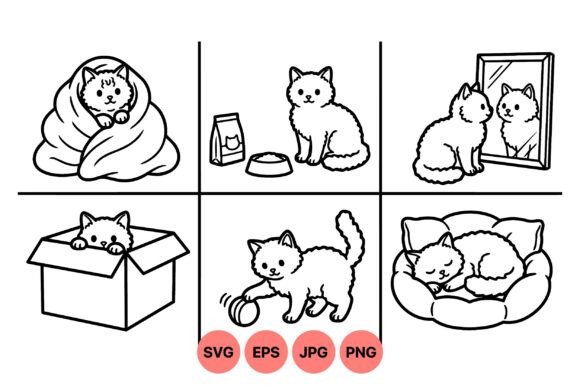
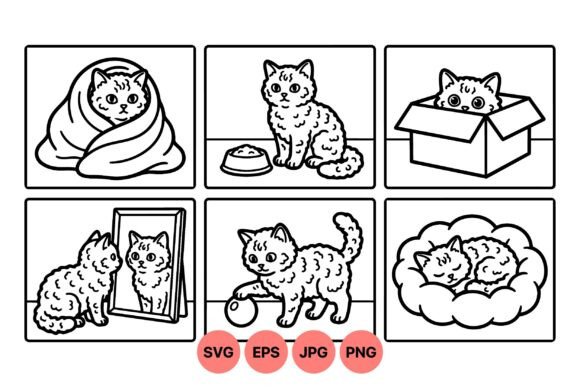
When I opened Cute Fluffy Kitten Line Art, what struck me wasn’t just cuteness—it was clarity. This isn’t a busy illustration packed with shading or gradients. It’s clean, confident monochrome line art: six distinct kitten moments—wrapped in a blanket, beside a food bowl, peeking from a box, gazing at its reflection, batting a ball, and sleeping in a soft bed—all drawn with consistent line weight and gentle curves. As an embroidery designer who’s stitched hundreds of animal motifs, I immediately sensed its potential: it breathes space, invites detail, and avoids visual noise that trips up stitch execution.
Real-World Use: That Tote Bag Moment
Last week, I prepped a custom embroidered tote for a local boutique—a gift for new pet parents. I chose Cute Fluffy Kitten Line Art as the centerpiece, scaling it to fit a 4” hoop on natural canvas. Why? Because line art translates beautifully to running stitch and satin stitch outlines—it reads clearly even at modest sizes, and the playful variety of poses gives customers *choice* without needing six separate files. The sleeping kitten became the main motif; the peeking-from-the-box version doubled as a subtle corner accent on the inside pocket lining. Customers loved the quiet storytelling—not too saccharine, not too minimal. Just warm, handmade, and unmistakably feline.
Where It Shines (and Where It Needs Care)
Cute Fluffy Kitten Line Art excels in projects where legibility, charm, and stitching efficiency matter:
- Custom apparel: Works cleanly on sweatshirts and tees—especially when paired with light stabilizer and medium-weight thread. The open shapes avoid dense fill areas that pucker thin cotton.
- Baby embroidery: Ideal for onesies and burp cloths—the soft postures and rounded lines feel gentle and age-appropriate. No sharp angles or tiny details that snag delicate skin.
- Patches & aprons: Holds up well as an embroidered patch thanks to its bold contours and balanced negative space. On linen aprons, it reads like hand-drawn charm—not machine-perfect, but intentionally human.
- Holiday & boutique gifts: Fits naturally on tea towels, pillow covers, and nursery decor. Its monochrome nature means it adapts effortlessly to seasonal palettes—navy thread for Christmas, sage for spring, blush for baby showers.
But—and this is key—I’d use caution on:
- Curved surfaces like caps: The food bowl and reflection scenes include small circular elements that may distort if hooped tightly on structured crowns. Test first on scrap cap fabric.
- Dark or textured fabrics: While line art usually contrasts well, very nubby weaves (like heavy burlap) can blur fine strokes. Stick to smooth cotton twill or quilting cotton for best definition.
- Tiny hoops under 3”: The “looking at reflection” pose includes delicate whiskers and a subtle mirror outline—these risk stitching loss below 3.5”. Simplify or omit if scaling down aggressively.
- Frequent-wash items: Since it’s line-based (not dense fill), stitch retention depends more on stabilizer choice than density. Use tear-away + light cut-away combo for kitchen towels or baby bibs.
What It Adds to Your Finished Product
Cute Fluffy Kitten Line Art doesn’t just decorate—it elevates perception. On an Etsy listing for personalized baby blankets, it signals care and intentionality. On a craft fair apron, it feels curated—not generic clipart. Its monochrome simplicity builds trust: buyers recognize it as a design asset, not a stock shortcut. And because the poses are expressive but not overly literal, it avoids dating quickly—unlike trend-heavy graphics, this stays quietly relevant across seasons and customer ages.
Practical Notes Every Embroidery Designer Should Check
Before cutting thread or uploading to your machine:
- Test on scrap fabric first—especially if using textured or stretchy material. Watch how the “ball play” curve stitches out; slight tension shifts can flatten roundness.
- Review stitch density in your software. Monochrome line art often imports with light running-stitch defaults—confirm it’s optimized for your fabric weight. Too sparse = fragile edges; too dense = stiff outlines.
- Check hoop size compatibility. All six scenes fit comfortably in a 5×7 hoop at full scale—but if you’re mixing poses (e.g., three small kittens across a tote strap), verify spacing in your layout tool.
- Try black-and-white mockups. Since it’s monochrome line art, test how it reads on both light and dark backgrounds. Does the “blanket wrap” scene hold shape against charcoal fleece? Yes—but only with high-contrast thread.
- Verify licensing for commercial use. As an Illustrations file marketed for craft business and digital product sellers, confirm whether resale of finished embroidered items or digital previews (e.g., printable mockups) is permitted before listing on Etsy or your small shop site.
Final Thought: A Quietly Versatile Asset
Cute Fluffy Kitten Line Art isn’t flashy—but that’s its strength. In a market saturated with over-rendered pets and cluttered themes, it offers breathing room, adaptability, and quiet professionalism. Whether you’re stitching a single personalized gift or building a cohesive line of nursery-themed Graphics for your digital shop, this design supports your voice instead of competing with it. It’s the kind of embroidery file that makes clients say, “It looks handmade—like you *drew* it just for me.” And in today’s craft economy, that’s worth more than perfect pixels.