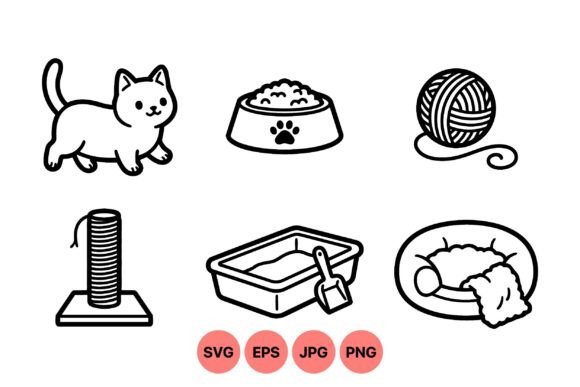
Cute Cat Care Clipart Set
A Designer’s First Glance: Simple, Sweet, and Stitch-Ready
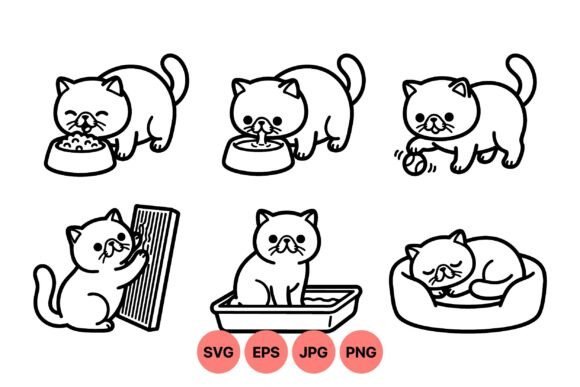
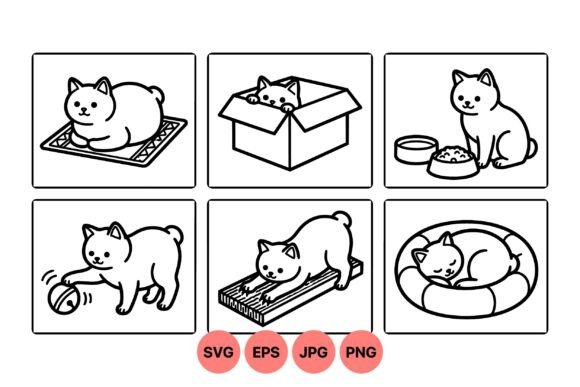
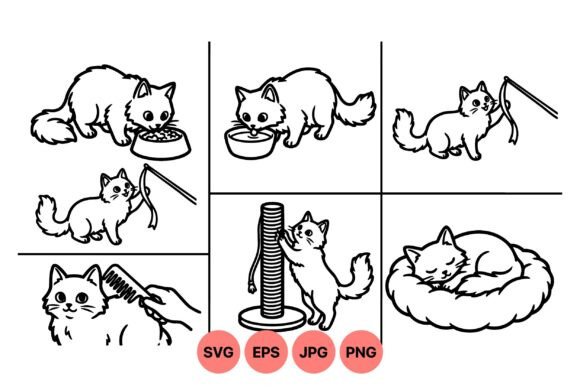
Opening the ZIP folder for Cute Cat Care Clipart Set, I immediately felt that quiet satisfaction of finding clean, intentional line art—not overworked, not overly stylized, but full of gentle personality. Five scenes: cat eating, drinking, playing, scratching, sleeping. All black and white, all centered, all drawn with consistent line weight and breathing room. This isn’t clipart meant for scrapbooking alone—it’s built for translation into thread. As a designer who regularly converts illustrations into machine embroidery designs, I looked first at negative space, contour clarity, and implied motion. Each pose reads instantly, even at thumbnail size. That matters—whether you’re stitching a 3-inch patch or scaling up for a pillow cover.
Where It Shines: Real Projects, Real Customers
I tested Cute Cat Care Clipart Set on a custom embroidered tote bag for a local pet boutique—and it landed beautifully. The “sleeping peacefully in a soft bed” motif stitched cleanly onto medium-weight canvas using a lightweight cutaway stabilizer and standard 40-weight poly thread. Customers loved the quiet charm: no busy details to distract, no fussy gradients to fight in stitch. It read as handmade, not mass-produced. That same design translated smoothly to a baby onesie (using tear-away + topping for knit stability) and a linen tea towel (where the line art’s simplicity kept the texture from swallowing the stitches).
For Etsy sellers and small shop owners, this set works especially well for curated collections: think “Cat Lover Starter Pack” with matching digital mockups, printable care cards, and a single cohesive embroidery file per scene. Because each image stands alone yet belongs to a family, it supports brand consistency across products—from embroidered aprons for a cat café to holiday gift tags with the “playing with a toy” motif.
Where to Pause—and Why
Not every surface welcomes these lines equally. On dark fabric, contrast depends entirely on your thread choice—so test light grays or creams before committing. On stretchy knits like sweatshirts, the “drinking water” and “scratching post” poses require extra stabilization under the arms and along curved limbs; thin lines can pucker if tension isn’t dialed in. And while the sleeping cat’s rounded form flows naturally over a pillow curve, the “eating food” scene—with its tighter bowl detail—needs careful hooping on caps or curved seams. Tiny elements like the toy’s tail or water droplets? They’ll hold up fine at 3+ inches, but shrink below 2 inches and they risk disappearing in fill stitch or running stitch density.
Design Assets That Build Trust
What makes Cute Cat Care Clipart Set more than just another graphics download is how it supports professionalism in finished product. Because it’s line-based—not shaded or textured—it avoids common embroidery pitfalls: no false gradients, no misleading shadows that confuse stitch logic, no hidden layers that vanish when converted. That means less time troubleshooting, fewer customer questions about “why does the cat look blurry?” and more confidence when listing on Etsy or pitching to a boutique buyer.
It also elevates perceived value. A personalized gift—a child’s name embroidered beside the “playing with a toy” cat—feels thoughtful, not generic. The visual calm of the sleeping cat on a nursery pillow communicates care and intentionality. That kind of resonance doesn’t come from complexity. It comes from restraint, rhythm, and recognition.
Practical Notes Every Embroidery Designer Should Check
- Test first on scrap fabric—especially if using textured weaves, terry cloth, or blends. Line art reveals stabilizer gaps faster than bold shapes.
- Review stitch density before scaling. These are illustrations—not pre-digitized embroidery files—so your digitizer (or software) must interpret line weight into appropriate satin or running stitch spacing.
- Confirm hoop size compatibility. The sleeping cat fits neatly in a 4×4 hoop at full scale; the “scratching post” may need a 5×7 for legible detail without compression.
- Inspect corners and curves. The toy’s looped tail and water bowl rim are smooth in SVG—but check how those translate into stitch paths. Jagged vector points become jagged stitches.
- Mock up in black and white. Since the original is monochrome, avoid assuming color will “save” weak contrast. If it doesn’t read clearly in grayscale, it won’t stitch clearly either.
- Match stabilizer to end use. For baby embroidery or items needing frequent washing, pair with wash-away + cutaway. For decorative patches, try fusible + tear-away.
- Verify licensing before commercial use. This is an Illustrations pack—not a ready-to-stitch embroidery file. Confirm whether resale of finished embroidered goods or digital embroidery files derived from these assets is permitted.
Final Thought: Less Is Truly More—When It’s Done Right
Cute Cat Care Clipart Set doesn’t shout. It invites. It gives space—for thread, for fabric, for the person holding the finished item. As a designer reviewing dozens of cat-themed graphics each season, I keep returning to sets like this one because they respect the craft: no forced cuteness, no visual noise, no assumptions about your machine or materials. They assume you know your process—and hand you a starting point that honors it.
Whether you’re stitching a single custom sweatshirt for a client or building a full line of cat-themed kitchen towels for your small shop, this set earns its place in your design assets. Not because it’s flashy—but because it’s faithful: to the subject, to the stitch, and to the quiet joy of making something truly seen.